Category Archives: politics

The Campaign Trail: Day One

Occasionally  I throw around the idea of running for public office some day. I have a family history of public service…and big ideas about how to help San Antonio.

Yesterday, I got a little taste of what my life would look like if I were a candidate for public office in San Antonio.

8:30-9:30 am – Neighborhood Board Meeting: discussion of budgets, 501(c)3 status updates, and revisions of standard operating procedures. Also some really exciting stuff.

9:37-11 am – go to meet a friend at the Farmer’s Market, end up running into 10 other friends, holding am adorable baby, meeting friends-of-friends, etc.

Noon-3pm- Juneteenth Celebration/Neighborhood Association Fundraiser. Knowing this was a neighborhood association thing, I expected the usual mix of African American, white, and Hispanic folks serving up bbq plates and hanging out at picnic tables.

Instead, when we got out of the car at the park we’d never been to on the city’s southeast side, the beehive in my stomach erupted, like on the first day at a new school. We looked like conspicuously pasty glowworms.

For the next three hours I had a blast serving up grilled chicken and potato salad… and  thinking of a compelling answer in case someone finally voiced the question that was surely on everyone’s mind: “What the hell is that yuppie white girl doing in here?”

Of course, everyone was far too gracious for that. They said, “Thanks for helping out! Hope you had fun!” And I did.

4-5:55pm– Lake|Flato pool party. Where I (along with the senior partners in the firm) constantly whispered “who’s that?” to Lewis whenever new hires and interns came through the gate.

6-8pm– Dinner with friends. It ended at 8 only because I could tell that I was about to fall asleep sitting upright, and that control over what I said was waning.

If I were actually stumping, I’d have headed off to a gala, benefit, or rally. But by this point, I’d already made up my mind. I’m not running for office. I thoroughly enjoyed each activity today…but when they fire out of the canon bam-bam-bam like that…I don’t think I stopped talking until 8pm when I simply stopped making sense.

I know someday I’ll think I’ve changed my mind. The desire to do good and effect change will convince me that, yes, I can totally take on one more thing. I’ll be convinced that it will be energizing and exciting.

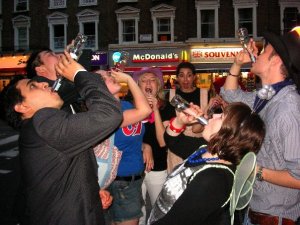
I know myself, and that’s the sort of lapsed memory/judgement/ability to asses reality that gets me into trouble every time. So, in an effort to do my future self a favor…I’m going to post the following pictures, and just nip that campaign in the bud.

Future Bekah, this is for you. You’ll thank me later:

IMG_3738[1] No hands IMG_3736[1] Strawpedo Shots Karaoke Christmas

The Curious Urbanite Learns about School Choice

There’s a new pro-choice movement in town. Instead of clinics and doctors, this time it’s about schools and teachers. Particularly in areas with above average high school drop our rates, like inner-city San Antonio.  The curious urbanite will be curious about what this means for any children she needs to be educating in the future…

School choice is the term used to refer to a movement that includes everything from vouchers to homeschooling, as well as public charter schools. It is based on the assertion that parents who find themselves in failing schools should be given options to look elsewhere for their children’s education.

On March 26, Texas Senate Bill 2 is scheduled for public hearing. This bill will, among other things increases support for charter schools, including those not incorporated by the school districts in which they reside, like IDEA and KIPP. It will also establish a Charter Schools Authorizing Authority.

In advance of that hearing, Texans Deserve Great Schools held a press conference on March 22 at IDEA Carver, formerly The Carver Academy, on Hackberry Street.

Speaking at the press conference was Sen. Dan Patrick, the chair of the Senate Education Committee, author of the TX SB 2, and advocate of school choice.

Perhaps the strongest argument for school choice, one made by Patrick, is that it has always existed for those wealthy enough for private school and mobile enough to shift school districts. However, for those bound by income and geography to struggling school districts, there is little that they can do, however much they might want more opportunity for their child.

Texas Senator Dan Patrick at a press conference on Policy Recommendations for Texas Education System Transformation

“Just because you are poor, in the valley, or in the inner city doesn’t mean you don’t care about your child…” Patrick said. He also pointed out that it was misguided to think that one educational approach would work for 5 million students saying, “Anyone who has more than one child knows that in the same family with the same upbringing, children learn differently.”

A key element of school choice, the one addressed by TX SB 2 is the availablility of charter schools.

“There are some that resist innovation, transparency, and rigor,” he said. Which is what Texans Deserves Great Schools proposes to bring to table.

He argued that with 5 million students in public schools, the idea that charter schools represent a serious threat to public school enrollment (and funding) is simply unrealistic. Right now, with approximately 150,000 students enrolled, charter schools account for the smallest portion of the pupil share in the state.  With and 80,000/year growth rate, it is likely that 95% of all Texas students will continue to be enrolled in public schools.

Victoria Branton Rico at a press conference on Policy Recommendations for Texas Education System Transformation
Victoria Branton Rico at a press conference on Policy Recommendations for Texas Education System Transformation

Patrick, along with Victoria Branton Rico, Chairwoman of the George W. Brackenridge Foundation, made the case that adding options for families and students would not hurt existing public schools. On the contrary, they cited research showing how competition strengthens public school performance, which only bodes well for public school funding.

“Being pro-charter is not being anti-public schools,” Patrick said.

Branton Rico reiterated some of the challenges facing public schools, and celebrated advances in research that have allowed policy to move forward addressing the issues.

“A few years ago this was a policy dead end,” she said, going on to reference studies by MIT, Harvard, and others about the effectiveness of the high performing charter schools. The most compelling statistic being that students in charter schools receive an average of four more years of education than students in traditional public schools – which basically means that their drop-out rate is drastically lower. Dropping out of high school has a high statistical correlation to going to prison, Branton Rico pointed out.

Branton Rico highlighted Texans Deserve Great School’s four core principles to transform Texas schools (more in-depth explanations of the policies can be found here):

1) Implement proven education technologies and teaching innovation – these include blended learning, online classes, vocational training classes, allowing students to test for credit in classes without “seat time,” and innovation waivers for schools looking to pilot new program.

2) Make high-performing school options available to every Texas family – most notably by removing the cap on charter schools, allowing families to choose any public school they wish (while giving priority to the school’s local residents when a school reaches capacity), equitable funding and facility access for charter and traditional public schools, and increasing principals’ control over vital areas that affect campus effectiveness and efficiency.

3) Invest in the best teachers and teaching policies to improve student learning – which would increase rigor and flexibility on everything from teacher training, to pay-scales, to giving teachers full use of the grading scale (even zero) to evaluate student work.

4) Integrate an emergency, expedited fix for any failing Texas public school – the main point of which is to allow for more accessible ratings (such as an A-F scale) and swifter intervention for failing schools.

The final speaker at the press conference was Rolando Posada, executive director of San Antonio IDEA public schools.

Rolando Posada at a press conference on Policy Recommendations for Texas Education System Transformation

He heralded a 100% increase in IDEA schools in Texas over the next five years, from 28 to 56, which proposes to increase college graduates in Central Texas and the Rio Grande Valley by 50%.

“Solving the education problem means that we are creating people who can solve the other problems our country faces,” Posada said.

IDEA embraces blended learning and the other innovative techniques promoted by Texans Deserve Great Schools. He referred to his students as young readers and mathematicians, emphasizing their potential to achieve.

“We focus on character, and acheivement remarkable and naturally follows,” Posada said.

He went on to praise the efforts of Sen. Patrick for moving past lip service and into action saying, “The time has come to replace cliche’s with actual transformation.”

For those seeking transformation on both sides of the school choice movement, TX SB 2 will be important to watch.

The Curious Urbanite Learns about Water

From first through seventh grade I attended New Braunfels public schools. Having nothing to compare with this experience, it was not until adulthood that I realized what is so special about a New Braunfels public school education.

To this day, I can tell you that the Comal River is 72.6 degrees year round. It is fed by a spring from the Edwards Aquifer and home to the blind salamander and fountain darter, both of which are endangered. New Braunfels was home to Ferdinand Lindheimer, the “Father of Texas Botany,” as well as a progressive German settlement that made a big impression on Frederick Law Olmsted as he journeyed across Texas.

I don’t know if the testing regimen still allows for it, but the local history and ecology taught to New Braunfels ISD 3rd graders at Herman Seele Elementary in 1992-93 was the stuff of naturalist fantasies. I learned to see myself as a part of the unique civic and natural history of a spring fed town.

Understanding where water comes from is essential for urban living. We run a high risk of seeing it as an inexhaustible resource, generated by nozzles, knobs, and hoses. In the area served by the Edwards Aquifer (and the Trinity Aquifer beneath it), the conversation is peppered with words like “recharge zone” and a random number somewhere in the 600’s that tells us when we can and cannot water our lawns.

Local news and conversation is flooded with juicy information about latest water politics and crises, so the dynamic nature of water issues does not require specialized knowledge once you are able to interpret the language. A basic understanding of historic geopolitics is helpful as well.

Sounds like a quest for the Curious Urbanite.

San Antonio River

San Antonio River

The Curious Urbanite’s Water Issue Primer

“J-17”– Every night on the news, the weather man announces the aquifer level.  The record high was in 1992 at 703 and the record low was 612 in 1956. This number is the primary determinate for water usage restrictions in the city of San Antonio. So how do they get that number?

They get it from one artesian well near the cemetery at Fort Sam Houston, J-17. Like all artesian wells, the water in J-17 is being pushed up toward the surface by underground water flowing from higher altitudes is the north and west (the contributing and recharge zones..more on that later). However, unlike Comal Springs or San Marcos Springs, J-17 does not bubble up above the surface. The water simply rises and falls within the natural well, depending on how much water pressure is acting upon it from the aquifer.

If the water in J-17 reaches 640 feet above sea level…the weatherman says that aquifer level is 640. Which, I believe, is Stage 4 water restriction and you can kiss your grass goodbye. If it reaches 680 we all run around naked in our sprinklers…which is stupid because if we conserved water at 680 the way we do at 640 then we would never see 640.

Zones– Three zones comprise the Edwards Aquifer. Contributing zone, recharge zone, and artesian zone. The contributing zone is not as helpful as it sounds. It is the high, dense land where rainfall runs into streams and rivers which travel downhill. It’s where water collects, but it doesn’t enter the aquifer until it reaches the recharge zone. The recharge zone is area that is shaken and cracked so that water can fall down into the aquifer from the surface, and the abundant Trinity Aquifer can share water with the Edwards.

The thing about the recharge zone is that it is small and delicate. And in high demand for development. But every piece of ground covered with a house or a shopping center is no longer cracked and porous. And every contaminate that runs off of a recharge zone parking lot into the cracks and pores around it goes straight into the same aquifer we drink out of.

The third zone is the artesian zone. That’s us, the big city with our 100 gallons per person, per day. It’s also, though, the natural springs in New Braunfels and San Marcos. When I was a kid, we used to go to Comal Springs and drink from the ground, claiming that it was the purest water in the world because it was coming straight from the aquifer.

Fun fact: it can take up to 200 years for water to make it from the furthest point in the contributing zone to the Comal Springs. Had we known that we might have been more squeamish about drinking “the world’s purest water.”

Water Quality– right now, the Edwards Aquifer Authority (established in 1993 to keep the Federal Government from seizing control of the Aquifer under the Endangered Species Act) has the unenviable job of regulating how much water can be pumped from our limestone sponge. While this is a vast improvement over the wild west style “rule of capture” law, which basically said that ground water belonged to whomever could access it (as opposed to surface water, which was tightly regulated to keep people from using rivers as their personal water tanks), it does little to address the compromising elements to our water quality.

EAA is take valiant stabs at water quality management, but they face geopolitical hurdles on both the quality and the quantity fronts.Because the aquifer works as a filtering agent, the quality issues are not quite as dire as the quantity issue, which seems to be in perpetual DEFCON 3. So until we start dying of cholera, we’re going to have to live with some asphalt sealant in the runoff.

Agriculture in the west and development in the north are greatly inconvenienced by restrictions that will keep springs flowing and drinking water clean in San Antonio, New Braunfels, and San Marcos. More to the point: Texans have a hard time being told that what is on their land is not strictly their own.

Forgive me if I rant a little…

If the 3rd graders at Seele Elementary were told that their precious Comal Springs would soon be toxic because the recharge zone was all paved over,  they would be so confused. They would wonder if the culprits had known what they were doing. Did they know that they were hurting people on the other end of the water table? They would wonder why no one stopped them. If the water bubbling out of Comal Springs belongs to all of us, how can it belong to one person when it’s under the ground in Bandera?

For the large populations dependent on the Edwards Aquifer for water (and thus, life), a new understanding of geography and land ownership is necessary. It was not a mayor or a governor who decided that water would flow from Bandera and the Hill Country to San Antonio and the north eastern springs. The flow under the surface are beyond taxes and districts. What a farmer does in Uvalde matters to a family in San Antonio, not because the government wants to tell you what to do with your land, but because this is how the water works. It flows from one to another without stopping to ask “who do I belong to?”

For this Curious Urbanite, knowing how the aquifer works made the litigious grabbiness of many of my fellow Texans seem absurd and immoral. The more I learned about the resources we share, the more I stood in amazement at those who consider it their right to screw the rest of us. And, for one more moment on my little urban soap box, I say that it is ironic that we smile upon mission agencies trying to bring clean water to Sub Saharan Africa while we are so busy dying on the hill of “keeping the government out of my business” that we are compromising that very resource for our own neighbors.

The Curious Urbanite learns about Transportation

No one, on the morning after economic collapse, breaking scandal, or other such meltdowns of public importance says, “If only we’d known less.” We can argue all day long about what-will-fix-it and what-will-break-it, but at the end of the day an informed disagreement is better than uninformed consensus.

It is our civic duty to be informed. I am convinced of this.

Transportation has been on my mind a lot lately, as San Antonio tries yet again to get some sort of rail system off the ground (or on the ground, rather). As I’ve begun cultivating my own Curious Urbanite, here’s what I would recommend to anyone looking to do the same.

Read:

Jacobs, J. The Death and Life of Great American Cities.

Really, everyone should read this, period. It’s dated, but eerily continually relevant. Jacobs was a prophet in the wilderness for how we were destroying our cities, and her influence on planning has been markedly more successful than other wilderness prophets before her (at least among their contemporaries).

Her main arguments are that we need lively, usable sidewalks where diversity breeds community. She has great things to say about parks, district-making, gentrification (which she calls “unslumming”) and automobiles. As transportation has origins and destinations as its raison d’etre, it’s helpful to learn about them in context.

IMG_0236[1]

Speck, J. Walkable City

One of Jacobs’s disciples, Speck has basically produced a modernized version of her work. His goal is to point out first, why walking should be our preferred mode of transport (health, ecology, economy, community and safety), and then gives ten suggestion for how to create a walkable city. He’s funny and irreverent, and incredibly easy to read. Neither book is by any means dry jargon, but Speck is of our time and his humor is current.

Visit:

Your Local MPO

A Metropolitan Planning Organization, (MPO) controls the transportation dollars for every city over 50,000. They are the ones who dole out funds for the potholes you hate, the bike paths you love, and the frontage roads on which you’ve become dependent.

In San Antonio, our MPO has a 45 minute introductory presentation, and anyone in the community can make an appointment to visit the office and hear it. The engineer are incredibly friendly and eager to be understood. Which seems unusual for a government agency assigned with designating monies.

My feild trip to the MPO was enlightening. I learned about walkable neighborhoods, urban greenways, and railroad rerouting. More importantly, I learned how those decisions are made. I learned the term CAVEpeople: “Citizens against virtually everything.”

And at the end I got some decent swag.

New York City

Even if you’ve already been to America’s transit/walking sweetheart, go again with transportation in mind. After reading Jacobs and Speck, you’ll see the city through new eyes. Geekier eyes, yes, but it will elucidate some of the mystery that haunts us as we wonder, “Why can’t my city do that?”

NYC Highline

Do:

A walking/running/biking tour of your area. In San Antonio, for the sake of transportation, I recommend River City Run. It’s a three mile loop around downtown that helps participants understand the important landmarks as well as the walkability of various areas of downtown. With glimpses of dead zones, sprawling lots that interrupt the landscape, and other gaptooth issues in need of civic orthodontia.

29

My birthday, sadly, comes but once per year on January 31. And on it I do feel obligated to post something profound, or sentimental, or funny. Something reflective. Something hopeful. It’s the one day during the year when I can, sheepishly, with four words justify anything I want to without looking like a narcissist or a glutton. “Well, it’s my birthday…” So yes, I’m having cake, a second cocktail, a long lunch, and I’m going buy myself something.

Allow me to say, as my Christmas and New Year Posts may have let on, that I am so happy to leave 28 behind. My husband and close friends have said that they feel I have aged (though they kindly say “grown up”) more in that single year than the 27 preceding it. So there you have it. However, blog readers aren’t paid therapists, so that’s all you get to hear about.

There were lots of really great things last year. So in no particular order…28 reflections on a year of being 28-years-old, and one on being 29.

IMG_0539[1]

1) Complain all you want about Facebook birthday wishes being cheap. No one on Facebook should ever get to whine “everyone forgot my birthday.” Even if your mother, boyfriend, and co-workers do…your third grade babysitter and 2nd cousin from Iowa who you met for the first time last year, did not. I think we are a more celebratory culture for it. Thank you FB for acknowledging the importance of birthdays.

2) I wish life was an Aaron Sorkin ensemble drama. If he’s living in a fantasy world, which he is, I want to live there with him. The Newsroom made my summer and The West Wing coming to Netflix made my winter.

3) My last meal as a 28 year old was the most amazing bbq I’ve ever eaten. We had flights of craft beers, the best brisket known to man, and Texas Toast with bacon-drippings butter. UNREAL. My first meal as a 29 year old: a grapefruit.

4) Best discovery of the year: Birchbox. It’s helped me decide to start taking moisturizing and sun protection seriously. I think my 40-year-old self will thank my 28-year-old self for this.

5) All year I tried to mitigate the effects of sedentary desk work by getting up every twenty minutes (I work from home). Inevitably so much time would go by, and I’d forget to get up and walk around. Then we got a puppy. Problem solved.

IMG_0505[1]

6) Best books I’ve read this year: Cutting for Stone, The Shadow of the Wind, The Death and Life of Great American Cities

7) Writing for the Rivard Report may be the best thing that has happened to me outside of getting married. And maybe living abroad.

8)  I actually really like grapefruit, and all these years I had thought I didn’t. Good thing, I guess.

iPhone Jan 22, 2013 023

9) It’s a shame about me and science. I think, had a few things gone differently in high school, we could have had a long and loving relationship. I’m too late in the game to make a career of it, but thankfully the MacDonald Observatory and the Galapagos are open to the public.

10) I agree. Everyone should be in counseling.

11) There is nothing like working as an underling in ministry to make someone pro-union.

12) Balmorhea State Park is the greatest thing to happen to Texas.

13) I like running…I like hiking. But they should be kept separate.

14) Sometimes a side effect of something going incredibly right is the feeling that something has gone entirely wrong.

15) Non-New Yorkers have a really strong reaction against New York City because they feel like it’s elitist. Like the city has the personality of a sophomore English major with a design minor. Everyone I know in and from Manhattan is lovely and not the slightest bit elitist. But if they were, I think it would have something to do with their superior transit system, unlimited access to cultural institutions, walkable city layout, and the gold standard of public parks…times two.

NYC Highline

16) Biggest mystery of the year: why people are not flocking to the Lakes District in Chile.

Puerto Varas

CHile

17) Pets, plural, entered my life in full force this year, and I find myself enjoying caring for them. Whoever that girl was who didn’t want to be tied down…she’s long gone, and replaced with a snugglier, more motherly version who gets choked up watching “Love, Actually”

IMG_0520[1]

18) It’s just not worth it to drink too much anymore. Who am I kidding? I’m not mourning some wild season of life gone by. I never liked drinking too much. I did it, but I never liked it.

19) Lewis got me a bicycle for Christmas.  I was scared about traffic, but before my year was up I navigated the Lasoya roundabout (which I avoid even in my car) on two wheels. I love my bicycle.

IMG_0201[1]

20) Liz Lambert is my design idol. The diva’s in the details.

IMG_0363[1]

El Cosmico

21) The meaning of Christmas hit me full force when I heard the San Antonio Symphony playing at Haven for Hope this year.

22) It’s worth it to pay for a tour guide. When we were younger, and backpacking, getting lost was a luxury we could afford. We had all time and no money. Now that our time is money and vacations aren’t 40 days long, hiring a guide keeps the vacation in the “wow, that’s fascinating” zone and out of the “I told you the buses don’t operate on Sundays”

23) I have two age spots on my cheek. They will never go away. If you hold out long enough, your don’t need to get a tattoo. Your body will start marking itself up on its own.

24) I finally like fancy dark chocolate better than M&Ms. Lewis has won.

25) Having a beer or a glass of Pinot Grigio while watching the Colbert Report is a perfect way to end stressful days. This is a downgrade from tequila and Mad Men, which was how I was ending most days 6 months ago.

26) Prospect and refuge. It explains so much, and is perfectly illustrated by our puppy, who hides under the coffee table waiting to attack our shoes and steal Wiley’s toys.

27) The fact that semi-automatics, high-capacity magazines, and other guns designed to kill people are allowed to be bought or sold in any way completely baffles me. Completely. And I don’t really want anyone to explain it to me.

28) My husband loves me very much.

IMG_0545[1]

29) Everyday I am waiting for the answer to strike, as though God will throw it down like lightening, rather than unfolding it slowly like the way the sky looks before it it rains.

Ode to Mass Transit

When I was about four years old, I became obsessed with the VIA bus. My great-grandmother had a plush VIA character, a stuffed bus the size of a shoebox with big friendly eyes and string hair. I loved it. That probably had a lot to do with my proletariat aspirations as much as anything.

My parents indulged me, and I can still remember how it felt to get onto the bus and discover…NO SEATBELTS! People standing up while the vehicle was in motion! It was like I had entered an alternate universe where the most ironclad laws of childhood—my mother told us that if we didn’t wear our seatbelts that the police would take us away—were flagrantly disregarded. Thrilling.

The Tube

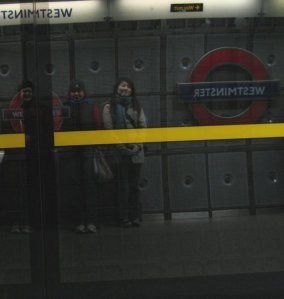
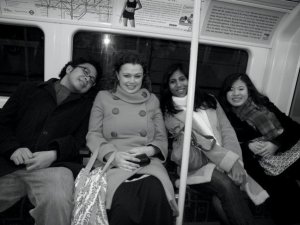
The Tube is a great place for taking clever pictures with friends.

My cousin and I rode the bus with my father from our house in Alamo Heights all the way down Broadway to the Witte Museum (approximately 1.5 miles), carrying our brown paper bags with hand-turkeys drawn on the front. I think they had snacks in them, you know, for the journey. My mom followed behind in the Jeep to bring us back home after a museum visit. It was such a lovely, public day in my young life.

When my editor at the Rivard Report sent me to cover the public meeting held by my once-idolized VIA Metropolitan Transit, I thought it would be a pretty dry story. Who could object to modern streetcars? Plenty of people, it turns out. The opposition has been vocal, and I’m up to my ribs in 20 page position papers, research documents, rebuttals, rebuttals to rebuttals.

Sometimes we don’t realize we’re passionate about something until we’re up to our ribs in the mud-lolly. These days, I am up to my ribs in mass transit mire.

So I’ve had to answer the question: what is it about public transport that I am so “for?” Not “what is your best argument ” But rather, what’s behind the logic?

Boarding the Seattle light rail.

Boarding the Seattle light rail, which happened to be scattered with feathers and sequins that day. Gay pride parade downtown. Never would have known if it hadn’t been for the shared space of the railcar.

I am for safety

No matter which way you shake it, roads are dangerous places! Especially with me and people like me driving on them. Every person opposing the streetcar should have to spend an afternoon with me in rush hour traffic. It will make you hope there’s a God and vehemently support not just public transport, but mandatory public transport.

And you know I’m not the worst one.

I am for planned routes

The only time I’m more dangerous than when I’m driving is when I’m lost driving.

In London, I rode the incredibly expensive tube for as long as it took to get oriented before switching to the iconic red, double-decker 80p buses for the sake of economy. But whenever I was going to a new part of town, I took the tube because there was no mistaking where you were heading, and where you were to disembark.

The clarity of rail, the consistency and comfort of knowing that every train stopping at this platform is going one of two clearly marked places, that put my lost or foreign heart at ease even in the most unreadable of cities.  Like London, Paris, and Rome. All of which seem to have been designed in a Yahtzee cup.

I am for transportation alternatives

Making car travel essential to getting around efficiently is the most irresponsible thing we can do as a society. There’s the bad drivers, the oil dependence, the pollution, the crowding.

More fun on the tube

More fun on the tube. I probably germed-up that handrail there.

But even within mass transit systems, there something to be said for alternatives. I lived in London for a year without a car, and utilized the full force of TFL (Transport for London).

Docklands Light Rail, the tube, trains to Gatwick, shuttles to Stanstead. You name it, I did it. I caught a lot of colds, because kids lick things on public transport. I had my bum grabbed more than once by handsy little boys. But as cruel as it could be, I was equally cruel to mass transit.

I vomited on the night bus.

I fare hopped on the Docklands Light Rail.

I sneezed in my hand and didn’t use hand sanitizer before grabbing the handrail on the tube.

Public transit is where we all pile in and hope that the person next to us is not contagious (socially or medically), and we discover how communicable the human condition can be. There are thousands of opportunities to be the best of yourself (offer the seat to the lady with the screaming infant), or the worst of your self, (turn up your iGadget so loud that other passengers can hear Marcus Mumford deafening you for life and glare at the screaming infant, as though it asked to be transported on the Typhoid Express in the middle of cold season).

I am for streetcars

The first time I used a modern streetcar to get around a city, I was alone in Munich, needing very much to get to the US Embassy (not nearly as exciting as it sounds). My train arrived in town around lunch time, and without speaking a word of German in a pre-iPhone world I was in and out of the Embassy by 2:30pm, with time to visit a hoffbrau before catching the afternoon train out. And it’s okay that I hit the hoffbrau because I wasn’t driving!  All on a modern streetcar.

VIA meeting where citizens proposed streetcar routes. It was hard to pick!

VIA meeting where citizens proposed streetcar routes. It was hard to pick from all the places we no longer wish to drive and park!

The next time I used a street car I was in Sarajevo (Post-war Bosnia. Surely San Antonio is ready to surpass the urban infrastructure of Post-war Bosnia…). I had one afternoon in which to take in the markets and bridges of the war torn Balkan capital. So I walked to a platform next to an overhead cable stretching in the right direction. I got on the steetcar, and I enjoyed an afternoon ogling mortar damage and buying bullet casings with “Bosnia” etched into the side. I say “enjoyed,” but I didn’t really like Sarajevo. It had very little to do with the city itself, and nothing to do with the streetcars. This was definitely the high point of the trip.

The Fertile Cliff

Aside from the copious amounts of shouting and weird, weird, too weird moment where Schmitt describes his sexual technique to a lesbian gynecologist, last week’s episode of New Girl, “Eggs,” did raise a notable topic:  waning fertility.

Cece and Jess contemplate their fertility.

Cece and Jess contemplate their fertility.

I was dubious at first that the egg-count blood test Jess and Cece took actually existed, but apparently it does. Actual fertility testing can be much more invasive (and I suspect would render sex about as romantic as trying to grow salt crystals on a string in 5th grade), but if all you want are hormone levels and an egg count, the blood test will do the trick.

As my contemporaries and I round the corner and start looking down the barrel of 30, this seems to be coming up more and more. Suddenly, we’re like the carton of milk that hasn’t been opened two days before the expiration date. If I eat cereal for every meal and make some creamy soup will that get me in under the deadline?

  • It was the earnest plights of the friends sharing their real (and doctor-abetted) fears of declining fertility.
  • It was the box of pre-natal vitamins given to me by a nurse, “because it can’t hurt to be ready.” (Funny, how unsolicited reproductive swag switches from condoms when you are 18 to pre-natal vitamins when you are 28).
  • It was Jessica Valenti’s book Why Have Kids?  She critiques the fertility panic induced by the science that demonstrates that women lose the majority of their eggs by age 35.

At some point in your late 20’s the world looks at you, raises their eyebrows and says, “No, but really. It’s time to get serious and make some babies.” Not that some women need the outside pressure. Plenty of friends report that every time they see a pair of tiny little baby booties they feel their uterus burning (I take cranberry pills, so that doesn’t happen).

If external and internal pressures magically align in a financially, relationally secure situation, then you are set. You’ve got all the support in the world to grant your own greatest wish. That only happens, maybe 2-3 times in life, so enjoy it.

However, if you are: 1) single, 2) enjoying your career, or 3) apprehensive about motherhood, then run a hot bath, pour a glass of wine, and put on your favorite “I can do anything!” anthem, because here comes the next great female dilemma.

If you are single…

It’s ironic that Jennifer Aniston’s character Rachel on Friends that brought up issues of 1) dating with babies in mind (The One Where They All Turn Thirty), and 2) having a baby as a single woman (seasons 8-10). Then she made the movies about it, The Object of My Affection and The Switch.  And now, real Jennifer Aniston’s baby-making is long term tabloid fodder to a frenzied, fanatical degree. Her personal and professional identity are inseparable from her womb-status.

(Jennifer Aniston and Eddie Cahill as Rachel and Tag, a romance doomed by family planning, photo from friends.wikia.com)

Jennifer Aniston and Eddie Cahill as Rachel and Tag, a romance doomed by family planning, photo from friends.wikia.com

When you are in your early 20’s, finding “the one” and having babies is like this sort of epic adventure with trolls and witches and even the precious golden ring.  My friends who are older and single tend to be more pragmatic. It’s really healthy, because they are no longer looking for an NFL quarterback who runs a Sub-Saharan philanthropy in the off season, and has a couple of best-selling records as a little hobby on the side. You know, just his poetry set to music.

But whether your approach is pragmatic or idealistic, most women don’t just get to say, “Alight. I’m going to get married now.” There’s this other person involved. This other person who will be fertile until he dies, and may or may not be in any rush to divert money from his travel/entertainment fund. Not to mention, if mating, not dating is the goal here, you have to consider whose genes you want to pass on. Here’s a hint: they may not be the ones that are most liberally scattered throughout the state.

In your 20’s the matrimony mavens tell you not to compromise. In your 30’s it’s like you’re President Obama and the dating pool is Congress (though probably still more likeable) and those kindly mavens become the pundits prattling on about the fiscal cliff. Or rather, the fertile cliff. The Bush Era tax cuts and your ability have children are about to expire.

So why not just hit up the sperm bank and have kids as a single woman? Best I can tell, unless you are a megawatt Hollywood star who can afford a full time nanny, chef, and chauffer, single motherhood is really hard. I can’t say that living childless into your 80s will be easy, but it seems less risky. Just my opinion.

If you like your career…

Here’s the rub, your late 20’s are the same time when you are probably either 1) settling into a new career( one that you actually like), or 2) finally making some headway in your career of choice.  Your most biologically fertile years are also your most professionally fertile. And nothing says, “thanks for the health insurance,” like getting pregnant.

In a country without mandatory paid maternity leave where very few companies offer child care or nursing flexibility, women bear the brunt of the professional sacrifice of having children. Not every time, but most of the time. It’s a mammary gland thing.

So the career that you love will enter a tenuous balance in which you are at the mercy of your employer to be able to tend to sick kiddoes, nursing infants, and doctor appointments without suffering professional repercussions. Legally, I don’t think they can fire you. But they don’t have to promote you.

Maybe you have a loving, pro-family, progressive work place. Maybe you don’t. Only one way to find out (convince the girl on the second floor to have a baby first and get her to tell you how it goes). My opinion: it is bat shit crazy that we do not have federally-mandated maternity leave and breast-feeding allowances.

On the other hand, if a woman wants to stay home, and her circumstances allow for that, I think she should. Nothing makes the office more thankless and dreary than comparing it to something else you’d rather be doing.

Women who are raised as equal achievers to men and then choose to stay home are incredibly industrious. They were raised to dream big, and that energy gets diverted into the business of home. They tend to do creative stuff with their kids, home, and food, and often venture off into other pursuits that are enhanced by home life. Hence most good Etsy merchandise, the plethora of part-time professional photographers, realistic cookbooks, and half the content of the internet.

Inevitably, both sides— those who choose to stay home with their kids, and those who go back to work— will feel like the world is against them. Our insecure ears have a special sensitivity to the insecure rants of the opposition. If you stay home, you’ll feel judged by feminazis. If you work, you’ll feel judged by the mommy blogs. Welcome to the world, new mom. You’ll never get it right.

Which leads me to my last Fertile Cliff crisis point.

Those who fear motherhood…

You are married to a successful, supportive, loyal man. Your job is very child-friendly. Or maybe you are just ready to be done with the corporate grind. So why are you not taking your temperature and keeping a fertility calendar?

Because the very assumption that if you are a normal female then you should want kids (badly) tells you there’s something very very loaded here. Your relationship to reproduction and the things you reproduce is going to define you more than you might want it to.

If your kids consume you, you’re getting it wrong. “You’ve got to have a life, or you’ll have nothing to give!”

If your kids don’t consume you, you’re getting it wrong. “You are the only mother your children will ever have.”

If you go to work, you’re getting it wrong. “Letting someone else raise your child.”

If you don’t go back to work, you’re getting it wrong. “Letting down the women of tomorrow.”

If you never complain, other moms resent you. If you complain too much, no one wants to be around you.

You cut your energy level in half for the next few years due to less sleep, more illness, and frequent trips to the doctor. Yet you’re expected to perform at the level of someone who had not recently been inhabited by another nutrient-sucking life form and then kept up all night being gnawed on by the same person.

They keep telling you it’s worth it…but then they say something about how they just want to pee without interruption. And the childless woman has no frame of reference for the “worth it” part, but she does know what it’s like to have sleepless nights and interrupted poops.

Women who fear motherhood are frequently cast as selfish, too. As though 1) their eggs are suffering psychological damage from neglect, and 2)  having your identity subsumed by a relationship is something trivial. A professor of mine, told this story:

“I had this student and she was brilliant. But she got married and had kids. And all I can think is that those kids are going to have no idea how talented their mother is.”

It’s true. Your mom could have been the first female President of the United States. You still woke her up in the middle of the night so she could feed you. You would not have loved her any less if she had been a washerwoman, as long as she hugged you and fed you. While that is immensely comforting, it’s also a little unsettling. It means that it will be incredibly hard to explain to my kids that there is something more important for me to do than to fix them a snack or read them a book sometimes. I thought my mom was awesome…”now drive me to soccer practice.”

It all adds up to the reality that motherhood is, yes, a very noble calling. But it’s a big one, and understanding that makes things a little…nervous.

For women facing the fertile cliff, every option seems perilous. Either have kids before she’s ready or maybe never get to have them at all. Or risk the expensive possibility of having to bring the medical industry into your bedroom. Whatever our choice,  there’s a Grover Norquist and a Timothy Geithner of fertility out there ready to tell you that if you’d just do what they say, you’ll avert disaster.

Satan Wants You Stupid- Reflection on the Election

Well, we’re all glad that’s over! And I’m allowing myself one quick moment to say this: it’s good to be in America, Bexar County, San Antonio, and Congressional District 35 this morning. But also, wow, Facebook “Friends.” Just because it’s instantly broadcast to all 1,500 of your “friends” doesn’t mean you should say it.

Now, on to reflecting.

My creative writing professor was one of the most quotable human beings ever to shout flamboyant aphorisms at trembling undergrads. As a Vietnam vet, a Fulbright Scholar, and a Baptist preacher, his reservoir of such ran deep and murky. One maxim in particular is forever branded into the mind of any student who survived his writing workshops: Satan wants you stupid. *shouted in a gravelly voice with an Expo marker hurled at the wall somewhere near a college student’s head*

His point is that ignorant people do damage rather than good.

Another withering wit would agree with him. Aaron Sorkin is on a one man campaign for a more intelligent America. Say what you want about his monochrome world of high-performing wise-asses (see The Social Network’s Jesse Eisenberg telling opposing counsel, “You have exactly half of my attention…”), the man is a crusader. Sorkin’s screenplays include A Few Good Men, The American President, and The Social Network. For television he wrote The West Wing, Studio 60 on the Sunset Strip, Sports Night, and now has a new series out on HBO called The Newsroom which just wrapped up its inaugural season.

Central to the plot of The Newsroom are classic Sorkinian protagonists Will McAvoy and Makenzie McHale. He is a moderate Republican who wakes up to smell the extremism in his own party. She is an bleeding-heart liberal who would die on her principals if anyone in the tough-skinned-but-tender-hearted news production room would let her. And of course, they have a romantic history, yielding enough painfully public workplace conduct infractions to make someone ask, “Where the hell is HR in this world?”

So yeah, it has its flaws.

But it, like Sorkin’s The West Wing, Charlie Wilson’s War, and even Studio 60, subscribes to a common belief: there are people in America who want to know the truth, and they are capable of taking a joke. There are citizens who want more than sensationalism and demagoguery, but who are willing and able to laugh at themselves. There are people willing to think before they throw stones.

In an election year, sometimes I doubt that. With each election we hear that this is the nastiest campaign season we’ve ever seen. That the candidates are throwing the lowest blows yet. That there’s more money going into manipulative television ads than ever before. And then there’s the steady roll of Facebook feed.  It’s enough to make you want to ask, “Where the hell is HR in this world?”

So what are the things that made America stupider during this election year?

The Straight Ticket: Blind Partisanship

Maury Maverick was a columnist for the Express News for 23 years until 1993. A member of the Texas Legislature during the Red Scare of the 1950’s, Maverick was the kind of legislator who was trying to save civil society from a medieval style witch hunt that would have jeopardized the academic integrity of the University of Texas and the peace and security of every private citizen in our state.

Maverick drew some fire, and I can understand why. He’s pretty crusty.  But as I’ve been reading through an anthology of his columns he sings the praises of brave public servants on both sides of the aisles. His opinions are founded in ideals, yes, but his arguments are built with logic. What if we subjected political stump campaigning to rigorous logical analysis?  What if cohesive statements, not soundbites/slip-ups/memes ruled the airwaves and internet?

I think the result would be that we would vote a mixed ballot, because there are great and not-so-great candidates on both sides. And the different levels and branches of government might not all benefit from the same political approach. And if our elected officials felt free to defy their party bosses, maybe we wouldn’t have so much gridlock during non-election years.

Campaign Speeches: Promises that don’t even make sense

When I was in sixth grade I ran for class president in a race  that really boiled down to me and one other kid. Our campaign speeches were broadcast over the school close-circuit television system. I promised to be fair and try to faithfully convey the desires of the entire student body to the teachers on issues of homework, school functions, and tests. My opponent promised to get a soda machine installed in the cafeteria. I asked a the principal if this was a realistic promise and she said, “no way.” But he still won. Guess what, still to this day there is no soda machine in that cafeteria.

I learned something during the 6th grade election. Campaigns are credit cards with no limit. You can charge and charge, but you’ll never pay them off.

But before we crucify our elected officials for not delivering, remember this: we would never elect the guy who made realistic promises. We’re the ones who keep demanding that our “tough questions” be answered in a campaign slogan. How many documents on economic policy did you read this campaign season?

Remember, it was the villain, not the hero of Sorkin’s A Few Good Men that said, “You can’t handle the truth.”

The Two-Party System: because there are exactly two kinds of people in this country?

I went to vote in the primary earlier this year, at the elementary school down the street from my house. As I approached the sign-in table, the cranky volunteer yelled out, while I was still at least 20 feet from the the table, “Republican or Democrat?” I stammered, stopped walking, but then decided not to run away with what was left of my independent sensibilities, and just did what I had come to do.

I know that there are third party candidates. I know that there are even some independents in Congress. But when you walk up to vote in a primary, you get two choices. Moderates and political amalgams weren’t viable (mostly) in 2012.  Log-Cabin Republicans and Democrats for Life are fringe elements of their party at best. A Latino Catholic has to choose between immigration and pro-life causes. A gay business owner has to choose between marriage equality and corporate tax breaks. The pressure to pick a team and drink their kool-aide is trickling down to the American people, and making public discourse a harrowing endeavor. Just try reading the comments on a news blog sometime.

The two-party system necessitates us vs. them thinking. Having only one aisle makes it too easy to point across it and say, “You’re what’s wrong with America!”

But this could change if we’d stop thinking on the back foot and start striving to understand why the intelligent people hold the opinions that they do. If we entered into discussion and widened the playing field. If we conceded a point every now and then and didn’t view changing our mind as political treason.

I think it’s dangerous to create a system wherein our leaders have to defy logic to get elected. I think it’s more dangerous that they have to maintain a 100% certainty that they and their party are correct, in spite of any evidence to the contrary. I think it’s dangerous to be stupid.

Mitt and Billy prove that many evangelicals put their hope in POTUS*, not Jesus

*POTUS

Growing up as an evangelical, voting Republican was a moral responsibility. Democrats were baby-killing socialists whose ultimate agenda included flushing God from the public sphere and eventually outlawing the freedom of worship. Republicans, by contrast, carried on in the tradition of our forefathers: they wanted to bring this nation back to its Christian roots.

It’s tempting to launch into what a Christian nation would actually look like, with the division of property (Act 2:41) and hospitality to strangers (Hebrews 13:2). Or even to look at the one simple statement that Jesus actually made about civic government (the Roman Empire, not exactly the bastion of moral integrity), “render unto Caesar what is Caesar’s (Mark 12:17)”, i.e. pay your taxes. But I won’t go there.

It is my suspicion that with a couple of exceptions evangelicals have been played for fools by candidates who realized that they could have the support of an entire voting block if they said the words “Christian nation.” Never mind that the founding fathers they tend to tout, and the ones who actually crafted our Constitution, espoused a sort of deist-Christian hybrid that historian Gregg Frazer calls “theistic rationalism” and were more concerned with the Magna Carta than with the Bible.

Nevertheless, the hardliners among the religious right have promoted whoever the outspoken Christian on the ballot is. Most famously, George W. Bush (who, once out of office, upset many fundamentalists by endorsing some of the more liberal positions on evolution and inerrancy of Scripture, per his Mainline Protestant affiliation).  Meanwhile they have taken a hard stance on the doctrines of Christian fundamentalism such as Creation and the deity of Christ, with their hallmark being unwillingness to compromise.

But now the choice is between a Mormon and Democrat. Regardless of Barak Obama’s religious beliefs, for many evangelicals his party platform means that, as I overheard at a Houston Chick-fil-a, “No man who calls himself a Christian could vote for Obama.” So, Mitt Romney is the default choice of most evangelicals. That’s actually not a big deal to me. He’s pro-life (today), he’s small government (ish), and he likes churches (and temples). All of this jives with the cherished beliefs of the religious right, and most evangelicals in general.

I’m even excited that my evangelical brothers and sisters are voting for a Mormon. I’m glad that they could recognize that personal beliefs about whether or not Jesus is the Son of God don’t have a huge bearing on one’s plans to stimulate the economy. They really don’t. So vote your values, vote your economic policy, vote for the candidate you like.

However, here’s what did finally disturb me. Rev. Billy Graham, like most hardline evangelicals, considers Mormonism a cult. Right or wrong, they’ve been teaching this for decades, I’ve heard it with my own ears. It was not until Mitt Romney’s campaign sought the endorsement of Graham that Mormonism came off the list of cults on Graham’s website.

Ken Barun, in a statement to the Charlotte observer said, “We removed the information from the website because we do not wish to participate in a theological debate about something that has become politicized during this campaign.”

Here’s why I don’t buy that: when Barak Obama came out in favor of gay marriage, the organization didn’t take down their page on homosexuality. In fact I’d argue that homosexuality is more politicized than Mormonism will ever be, unless Mitt tries to reinstate polygamy, which I doubt he will.

Do not be mistaken. Billy Graham did not have a change of heart on the subject of Mormonism. Nor has any hardline evangelical. What they have had is something far more profound: a change in savior. What the Graham crusade effectively said is NOT, “We’re willing to endorse this man, even though we disagree about religion.” Instead their action said that “truth” comes second to getting a conservative in the White House. Whether or not you believe that Mormonism is a cult is not the issue. Billy Graham’s organization does. And that would never have come down from his website if Joe and Sally Latter-Day-Saint had come to his door asking him to remove it. It wasn’t a display of tolerance, it was a display of faith in the conservative movement as the hope for America.

Rather than just coming out and endorsing Mitt in spite of the difference in faith, the organization decided to erase the difference. As Stephen Colbert so aptly put it, “All you have to do to be reclassified as a legitimate religion by Billy Graham is field a viable Republican candidate.”

If we Christians really believe what we say about Jesus’s love being the hope of the world, and not whoever sits in the White House, then we are free to vote for the best candidate regardless of his religion. We shouldn’t use religion as a campaign strategy, or edit our beliefs accordingly.