My Ideal Book Shelf

I’m a fan of questions like, “If you had to be stuck on an island with three books, what would they be?” And I’m a fan of the website Ideal Bookshelf, where you can have your all-star library immortalized…because the actual books are…mortal…? I guess people would rather have a drawing of their favorite books all together than just have the actual books together on a prominent shelf. Well, anyway, I think it’s a great website even if it doesn’t make sense.

But, alas, I don’t have $255 laying around to order my ideal bookshelf (immortal or mortal), so I just took some pictures of the actual books which are scattered throughout actual bookshelves in our house (some are missing, as I tend to give my books away). Ideal is a funny word, and these are not the best books I’ve ever read, nor are they the books I think everyone should read. This is more like the reference section for a study on my soul.

(I don’t mention the Bible in this list. I just think it’s in a different category for me.)

Little Women, by Louisa May Alcott

This was my favorite book for a long time. It introduced me to the concept of personalities and how they affected ones social, romantic and familial life. As I’ve said before, I always wanted to be a Jo. But I was such a Meg.

The Abriged version. G

Gave away the unabridged and kept the one with the great pictures.

The Count of Monte Cristo, Alexandre Dumas

This was the first seriously meaty book I ever read. It was in Mrs. Stephen’s 8th grade English class. We read it slowly, and discussed it thoroughly, which is the best way to read twisty-plotted 19th century French literature. Because we read slowly, I really really savored it, in a way that I don’t know if I have done since.

Mere Christianity, C.S. Lewis

This was another 8th grade read. It’s still my go-to resource my tri-yearly crisis of faith.
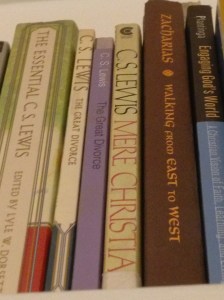
The big questions section

The big questions section

Ramona the Pest, Beverly Cleary

My 1st grade gifted-and-talented teacher read the entire Ramona series out loud to us, one chapter per class. Ramona Quimby was my original comedic hero.

Me, Katherine Hepburn

I love golden era movie star biographies. And Katherine Hepburn was more than just a starlet. I had no idea when I picked up her autobiography that she would become one of my favorite characters in history…not just entertainment.

My Golden Era Hollywood biography section

My Golden Era Hollywood biography section, with other notable biographies scattered throughout.

Til We Have Faces, C.S. Lewis

I read this at the most perfect moment. I was in a critical time of wrestling with bitterness and despair, and in it I saw both the peril of my soul and the antidote.

The Handmaids Tale, Margaret Atwood

Atwood inspires me. Social commentary, great story, and sci-fi, a genre I never thought I liked until I read The Blind Assassin. But in Handmaid she’s chillingly good.

One of the most easily identified pieces of cover art .

One of the most easily identified pieces of cover art .

Prodigal Summer, Barbara Kingsolver

This was a pick for Read the Change, and it’s not Kingsolver’s best work, but any stretch of the imagination. It gets preachy, and it’s not as tight as others. But it changed my mind about a lot of things. It taught me things that matter.

Neither Here, Nor There: Travels in Europe, Bill Bryson

Hilarious. Bryson and David Sedaris make me want to learn to write funny. Humor is so hard! Comedians and humorists are some of the most intelligent people in the world, I think. Plus, they get to tell the truth that no one else can. As Oscar Wilde said, “If you want to tell people the truth, make the laugh otherwise they’ll kill you.”

Manchild in the Promised Land, Claude Brown

Eye-opening in so many ways for this white girl.
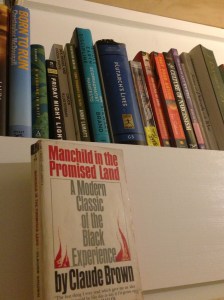
My reference section.

My reference section.

The Electric Kool-Aide Acid Test, Tom Wolfe

Literary journalism rocked my world. Wolfe is funny, but not laugh-out-loud like Bryson. Not knee-slapping funny. He’s more of a shake-your-head-and-chuckle funny. Because he just gets certain things. He observes the painful parts far too keenly to do anything but wince and giggle.

The True Confessions of Charlotte Doyle, Avi

I haven’t read this since 2nd grade, so it may be terrible. But I loved it then, and I love what it did for me. I still have the mental images and I still remember the feeling of being swept up in a story, which is important at that age. That’s why I think Harry Potter might have single-handedly saved literacy for a generation (no one take me to task on that, it’s hyperbole).

The Last Picture Show, Larry McMurtry

This was my favorite book after college, and I didn’t give much thought as to why…until I gave it to Lewis to read and he said, “This whole book is about perverse sexual situations.” Aha. Somebody was into being “edgy.” But still, really, it’s a great book.

Thankfully Lewis didn't read my "favorite book" until after he'd proposed.

Thankfully Lewis didn’t read my “favorite book” until after he’d proposed.

Matilda, Roald Dahl

Who didn’t want to be Matilda? And Roald Dahl is one of my heroes. What a talent, really. His imagination is both dark and whimsical, in proportions I aspire to attain.

The Complete Calvin and Hobbs, Bill Watterson

Gunnar, my brother, eventually shared this love with me. We can still quote the comics back and forth. The sense of humor in them is multi-layered and entertaining on most levels.
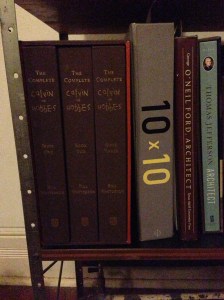
The Eames shelf of honor.

The Eames shelf of honor.

The Complete Stories, Flannery O’Connor

I wish I had a penny for every time I wanted to shout, “The lame shall enter first!”

IMG_0108[1]

Good, clean living

Just once, once in my life, I would like to go to the doctor and have the following discussion:

Doctor: Well we’ve gotten your labs back. All good, except for one thing. Have you been feeling a little woozy in the mid-afternoon?

Bekah: Come to think of it…yes! Nothing debilitating, but a little dizzy.

Doctor: That’s because you’re lacking a certain enzyme. Nothing dangerous at all, you just need to eat more salt and vinegar chips. A Coke every now and then wouldn’t hurt either.

They won’t say that. Ever.

On the other hand, there are some things that, no matter what the diagnosis, will be part of the prescription. They are universally accepted as good ideas for every single human being.

There’s been some concern lately about over-prescribed antibiotics. Yesterday’s wonderdrug is now prepping the world for the coming of the great Plague, from what I understand. Well, my theory is that people turned to antibiotics because they were tired of good, clean living as a way to ward off illness.

I get it, I do. But I have to admit there are times when I go to the dentist thinking, “Man, I have been so dutiful!” The hygeanist frowns as she looks in my mouth, “How often do you brush?”

“Twice a day.”

“Really could be three. How often do you floss?”

“Two or three times a week.”

“Needs to be every day. Do you use mouthwash?”

“Every night.”

“Go to morning and night.”

I just want to jump out of the chair and cry, “What do you want from me? What do I have to do to make you happy? When will you love me for who I am? Maybe I like a little tartar around the edges! What about that, huh? Did you ever think of that?”

And if you’ve ever tried to get out of exercise via sickness, good luck. “So should I lay off the gym for a while?” I ask as I feel like a 777 is lodged in my bronchial tubes.

“No, no. Moderate exercise will help as soon as your fever goes down.”

And as far as injury goes…two words: physical therapy. The worse you are hurt, the more you’re going to sweat.

Here are my list of things that seem to be beyond reproach when it comes to good, clean living. Cheers to your health!

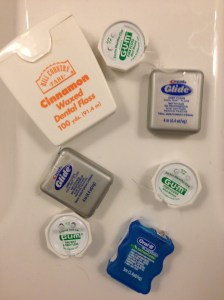
Flossing– We have an endodontist friend, and one night over dinner we were all joking about things that we know we should do, but don’t. Everyone was laughing and joking until I said, “And sometimes it’s just so hard to floss each of those back bottom molars.” The endodontist went completely straightfaced and said, “No, seriously. You have to do that.”

Probably not good that this stuff tends to accumulate faster than it is used around here.

Probably not good that this stuff tends to accumulate faster than it is used around here.

Sunscreen– I’ve always been on board the sunscreen wagon, but now that 28 years of tans from swimming and working at camps have consolidated into two age spots on my right cheek, I’m driving it. Too little too late, but the dermatologist said there is exactly a 0% chance of them connecting and taking over my face to give me an olive complexion.

The winter skin protection regimen.

The winter skin protection regimen.

Walking– The pros and cons of various kinds of exercises are continuously debated. My favorite was the article explaining the dangers of yoga. But walking, the original mode of human transportation, is universally accepted as a gentle, sustainable form of cardiovascular exercise.

These shoes were made for walkin'. Well, running really, but there's pleanty of walking being done.

These shoes were made for walkin’. Well, running really, but there’s pleanty of walking being done.

Sleep– I’ve never had a doctor recommend that I get some sleep, but my husband does. Usually right when I’ve just made a super-logical point, or when I’ve finally reached the tearful conclusion of my theory on how I’ve disappointed everyone.  I’m perfectly rational at 1am. I have no idea what his problem is.

The cure for the crankies.

The cure for the crankies.

Prayer– Long treated as the panacea for all that ails Christians, it seems to be gaining steam outside the walls of the church as well as meditation, centering, etc. Whether you believe that the efficacy of prayer is primarily internal (achieving balance and “chi,” if you will) or external (beseeching God to participate in your life and converse with you) more than likely if your condition falls somewhere near “agitation” or “melancholy,” then prayer is going to be part of the treatment plan.

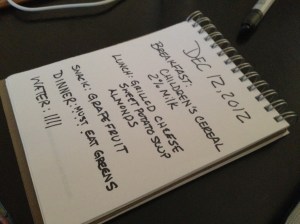
Keeping a food diary– why is this not something mandatory in schools? I went to public elementary school. They taught us how to balance checkbooks, follow the stock market, use a map, brush our teeth properly, and calculate our resting heart rate…where was this discipline? I’m too old to start new habits.

Today in the life of my mouth.

Today in the life of my mouth.

Drinking plenty of fluids– and then they go on to tell you to avoid sugary drinks, caffeine, and alcohol. So what they really mean is that you need to drink water. Man, are you in for a wild evening.

Recommended daily allowance. Also helps get the walking in, as you will use the restroom approximately 8-10 times a day if you are getting the recommended fluid allowance.

Recommended daily allowance of water. Also helps get the walking in, as you will use the restroom approximately 8-10 times a day.

Ode to Mass Transit

When I was about four years old, I became obsessed with the VIA bus. My great-grandmother had a plush VIA character, a stuffed bus the size of a shoebox with big friendly eyes and string hair. I loved it. That probably had a lot to do with my proletariat aspirations as much as anything.

My parents indulged me, and I can still remember how it felt to get onto the bus and discover…NO SEATBELTS! People standing up while the vehicle was in motion! It was like I had entered an alternate universe where the most ironclad laws of childhood—my mother told us that if we didn’t wear our seatbelts that the police would take us away—were flagrantly disregarded. Thrilling.

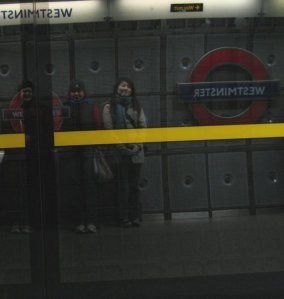
The Tube

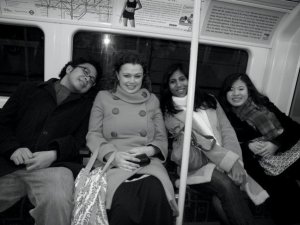
The Tube is a great place for taking clever pictures with friends.

My cousin and I rode the bus with my father from our house in Alamo Heights all the way down Broadway to the Witte Museum (approximately 1.5 miles), carrying our brown paper bags with hand-turkeys drawn on the front. I think they had snacks in them, you know, for the journey. My mom followed behind in the Jeep to bring us back home after a museum visit. It was such a lovely, public day in my young life.

When my editor at the Rivard Report sent me to cover the public meeting held by my once-idolized VIA Metropolitan Transit, I thought it would be a pretty dry story. Who could object to modern streetcars? Plenty of people, it turns out. The opposition has been vocal, and I’m up to my ribs in 20 page position papers, research documents, rebuttals, rebuttals to rebuttals.

Sometimes we don’t realize we’re passionate about something until we’re up to our ribs in the mud-lolly. These days, I am up to my ribs in mass transit mire.

So I’ve had to answer the question: what is it about public transport that I am so “for?” Not “what is your best argument ” But rather, what’s behind the logic?

Boarding the Seattle light rail.

Boarding the Seattle light rail, which happened to be scattered with feathers and sequins that day. Gay pride parade downtown. Never would have known if it hadn’t been for the shared space of the railcar.

I am for safety

No matter which way you shake it, roads are dangerous places! Especially with me and people like me driving on them. Every person opposing the streetcar should have to spend an afternoon with me in rush hour traffic. It will make you hope there’s a God and vehemently support not just public transport, but mandatory public transport.

And you know I’m not the worst one.

I am for planned routes

The only time I’m more dangerous than when I’m driving is when I’m lost driving.

In London, I rode the incredibly expensive tube for as long as it took to get oriented before switching to the iconic red, double-decker 80p buses for the sake of economy. But whenever I was going to a new part of town, I took the tube because there was no mistaking where you were heading, and where you were to disembark.

The clarity of rail, the consistency and comfort of knowing that every train stopping at this platform is going one of two clearly marked places, that put my lost or foreign heart at ease even in the most unreadable of cities.  Like London, Paris, and Rome. All of which seem to have been designed in a Yahtzee cup.

I am for transportation alternatives

Making car travel essential to getting around efficiently is the most irresponsible thing we can do as a society. There’s the bad drivers, the oil dependence, the pollution, the crowding.

More fun on the tube

More fun on the tube. I probably germed-up that handrail there.

But even within mass transit systems, there something to be said for alternatives. I lived in London for a year without a car, and utilized the full force of TFL (Transport for London).

Docklands Light Rail, the tube, trains to Gatwick, shuttles to Stanstead. You name it, I did it. I caught a lot of colds, because kids lick things on public transport. I had my bum grabbed more than once by handsy little boys. But as cruel as it could be, I was equally cruel to mass transit.

I vomited on the night bus.

I fare hopped on the Docklands Light Rail.

I sneezed in my hand and didn’t use hand sanitizer before grabbing the handrail on the tube.

Public transit is where we all pile in and hope that the person next to us is not contagious (socially or medically), and we discover how communicable the human condition can be. There are thousands of opportunities to be the best of yourself (offer the seat to the lady with the screaming infant), or the worst of your self, (turn up your iGadget so loud that other passengers can hear Marcus Mumford deafening you for life and glare at the screaming infant, as though it asked to be transported on the Typhoid Express in the middle of cold season).

I am for streetcars

The first time I used a modern streetcar to get around a city, I was alone in Munich, needing very much to get to the US Embassy (not nearly as exciting as it sounds). My train arrived in town around lunch time, and without speaking a word of German in a pre-iPhone world I was in and out of the Embassy by 2:30pm, with time to visit a hoffbrau before catching the afternoon train out. And it’s okay that I hit the hoffbrau because I wasn’t driving!  All on a modern streetcar.

VIA meeting where citizens proposed streetcar routes. It was hard to pick!

VIA meeting where citizens proposed streetcar routes. It was hard to pick from all the places we no longer wish to drive and park!

The next time I used a street car I was in Sarajevo (Post-war Bosnia. Surely San Antonio is ready to surpass the urban infrastructure of Post-war Bosnia…). I had one afternoon in which to take in the markets and bridges of the war torn Balkan capital. So I walked to a platform next to an overhead cable stretching in the right direction. I got on the steetcar, and I enjoyed an afternoon ogling mortar damage and buying bullet casings with “Bosnia” etched into the side. I say “enjoyed,” but I didn’t really like Sarajevo. It had very little to do with the city itself, and nothing to do with the streetcars. This was definitely the high point of the trip.

“Gift-wrapping my principles”

Years ago, I started giving “ethical gifts.”

Calling them that sort of implies that there is something unethical about gadgets, clothing, and books. As though if it wasn’t made by female entrepreneurs in Sudan then it must have been made in a sweat shop in China. Of course, seeing as how I have a Banana Republic Visa Card, if I really touted that shopping was evil, I would be the biggest hypocrite in the world. I’d be saying, essentially, “I buy myself whatever I want all year long, so that I can use the money I would spend on your gift for something tax deductible.”

Calling them “ethical gifts” was really my way of saying, “This gift was intended to bless you, and the world…well, really more just the world, and not so much you…because it’s a notebook made out of elephant poo.” (For the record the poo notebooks were among the more pragmatic purchases.)

My family is great, and they have always gotten the true spirit of my ethical gifts: for Jesus’s birthday, what he really wants is for us to love people more than stuff. They’ve even done some ethical shopping themselves, which has been fun.

But still I’d always have this dilemma. Because Jesus also loves my family, and giving them gifts is a good thing. So do I get them something that says, “I love you and thought you’d love this?” Or get them something that says, “I think Christmas is grossly over commercialized and we desperately need to remember that Jesus’s birth is not about stuff and gluttony?” It was really hard to find things that said both…especially on my budget. I’d love to get everyone gorgeous hand woven tapestries and metal work jewelry, but part of my being ethical at Christmas is not going into debt over it. Plus…have you ever tried to find “ethical” men’s gifts? It’s really hard. The men in my life are not scarf-wearers.

Some years everyone in my family got goats. Or rather, someone else received a goat purchased with the money I would have spent on buying my family members something else. One year they all got trees planted in their names. Such a big hit with kids…no. It’s not.

Some years were a hybrid. I did what I could and then shopped on Etsy “to support the artists.” Or I gave things loosely environmentally friendly. One year during the recession I gave gifts “to support small businesses.”

So this year, rather than hunt around for the perfect ethical gift with just the right balance of actual appeal and world-saving, I went back to my old ways. I still believe that Christmas is over-commercialized. I still cringe at the sentimentality and excess. But this year, I just decided to try really hard to show my love to my family by buying things they might like. Not the way they like volunteering (which they do! A lot!). But in a way they like stuff that they like.

Next year, they’ll probably all get shares of a milk cow.

But for this year, I returned to full-throttle Christmas shopping, and yes, I felt weird about it. SO, family, I hope you enjoy your presents. There’s a little piece of my principles in each box.

(“Gift-wrapping My Principles” is the holiday remix of the hit song “Alone in My Principles” by Jimmy Mattingly)

The Fertile Cliff

Aside from the copious amounts of shouting and weird, weird, too weird moment where Schmitt describes his sexual technique to a lesbian gynecologist, last week’s episode of New Girl, “Eggs,” did raise a notable topic:  waning fertility.

Cece and Jess contemplate their fertility.

Cece and Jess contemplate their fertility.

I was dubious at first that the egg-count blood test Jess and Cece took actually existed, but apparently it does. Actual fertility testing can be much more invasive (and I suspect would render sex about as romantic as trying to grow salt crystals on a string in 5th grade), but if all you want are hormone levels and an egg count, the blood test will do the trick.

As my contemporaries and I round the corner and start looking down the barrel of 30, this seems to be coming up more and more. Suddenly, we’re like the carton of milk that hasn’t been opened two days before the expiration date. If I eat cereal for every meal and make some creamy soup will that get me in under the deadline?

  • It was the earnest plights of the friends sharing their real (and doctor-abetted) fears of declining fertility.
  • It was the box of pre-natal vitamins given to me by a nurse, “because it can’t hurt to be ready.” (Funny, how unsolicited reproductive swag switches from condoms when you are 18 to pre-natal vitamins when you are 28).
  • It was Jessica Valenti’s book Why Have Kids?  She critiques the fertility panic induced by the science that demonstrates that women lose the majority of their eggs by age 35.

At some point in your late 20’s the world looks at you, raises their eyebrows and says, “No, but really. It’s time to get serious and make some babies.” Not that some women need the outside pressure. Plenty of friends report that every time they see a pair of tiny little baby booties they feel their uterus burning (I take cranberry pills, so that doesn’t happen).

If external and internal pressures magically align in a financially, relationally secure situation, then you are set. You’ve got all the support in the world to grant your own greatest wish. That only happens, maybe 2-3 times in life, so enjoy it.

However, if you are: 1) single, 2) enjoying your career, or 3) apprehensive about motherhood, then run a hot bath, pour a glass of wine, and put on your favorite “I can do anything!” anthem, because here comes the next great female dilemma.

If you are single…

It’s ironic that Jennifer Aniston’s character Rachel on Friends that brought up issues of 1) dating with babies in mind (The One Where They All Turn Thirty), and 2) having a baby as a single woman (seasons 8-10). Then she made the movies about it, The Object of My Affection and The Switch.  And now, real Jennifer Aniston’s baby-making is long term tabloid fodder to a frenzied, fanatical degree. Her personal and professional identity are inseparable from her womb-status.

(Jennifer Aniston and Eddie Cahill as Rachel and Tag, a romance doomed by family planning, photo from friends.wikia.com)

Jennifer Aniston and Eddie Cahill as Rachel and Tag, a romance doomed by family planning, photo from friends.wikia.com

When you are in your early 20’s, finding “the one” and having babies is like this sort of epic adventure with trolls and witches and even the precious golden ring.  My friends who are older and single tend to be more pragmatic. It’s really healthy, because they are no longer looking for an NFL quarterback who runs a Sub-Saharan philanthropy in the off season, and has a couple of best-selling records as a little hobby on the side. You know, just his poetry set to music.

But whether your approach is pragmatic or idealistic, most women don’t just get to say, “Alight. I’m going to get married now.” There’s this other person involved. This other person who will be fertile until he dies, and may or may not be in any rush to divert money from his travel/entertainment fund. Not to mention, if mating, not dating is the goal here, you have to consider whose genes you want to pass on. Here’s a hint: they may not be the ones that are most liberally scattered throughout the state.

In your 20’s the matrimony mavens tell you not to compromise. In your 30’s it’s like you’re President Obama and the dating pool is Congress (though probably still more likeable) and those kindly mavens become the pundits prattling on about the fiscal cliff. Or rather, the fertile cliff. The Bush Era tax cuts and your ability have children are about to expire.

So why not just hit up the sperm bank and have kids as a single woman? Best I can tell, unless you are a megawatt Hollywood star who can afford a full time nanny, chef, and chauffer, single motherhood is really hard. I can’t say that living childless into your 80s will be easy, but it seems less risky. Just my opinion.

If you like your career…

Here’s the rub, your late 20’s are the same time when you are probably either 1) settling into a new career( one that you actually like), or 2) finally making some headway in your career of choice.  Your most biologically fertile years are also your most professionally fertile. And nothing says, “thanks for the health insurance,” like getting pregnant.

In a country without mandatory paid maternity leave where very few companies offer child care or nursing flexibility, women bear the brunt of the professional sacrifice of having children. Not every time, but most of the time. It’s a mammary gland thing.

So the career that you love will enter a tenuous balance in which you are at the mercy of your employer to be able to tend to sick kiddoes, nursing infants, and doctor appointments without suffering professional repercussions. Legally, I don’t think they can fire you. But they don’t have to promote you.

Maybe you have a loving, pro-family, progressive work place. Maybe you don’t. Only one way to find out (convince the girl on the second floor to have a baby first and get her to tell you how it goes). My opinion: it is bat shit crazy that we do not have federally-mandated maternity leave and breast-feeding allowances.

On the other hand, if a woman wants to stay home, and her circumstances allow for that, I think she should. Nothing makes the office more thankless and dreary than comparing it to something else you’d rather be doing.

Women who are raised as equal achievers to men and then choose to stay home are incredibly industrious. They were raised to dream big, and that energy gets diverted into the business of home. They tend to do creative stuff with their kids, home, and food, and often venture off into other pursuits that are enhanced by home life. Hence most good Etsy merchandise, the plethora of part-time professional photographers, realistic cookbooks, and half the content of the internet.

Inevitably, both sides— those who choose to stay home with their kids, and those who go back to work— will feel like the world is against them. Our insecure ears have a special sensitivity to the insecure rants of the opposition. If you stay home, you’ll feel judged by feminazis. If you work, you’ll feel judged by the mommy blogs. Welcome to the world, new mom. You’ll never get it right.

Which leads me to my last Fertile Cliff crisis point.

Those who fear motherhood…

You are married to a successful, supportive, loyal man. Your job is very child-friendly. Or maybe you are just ready to be done with the corporate grind. So why are you not taking your temperature and keeping a fertility calendar?

Because the very assumption that if you are a normal female then you should want kids (badly) tells you there’s something very very loaded here. Your relationship to reproduction and the things you reproduce is going to define you more than you might want it to.

If your kids consume you, you’re getting it wrong. “You’ve got to have a life, or you’ll have nothing to give!”

If your kids don’t consume you, you’re getting it wrong. “You are the only mother your children will ever have.”

If you go to work, you’re getting it wrong. “Letting someone else raise your child.”

If you don’t go back to work, you’re getting it wrong. “Letting down the women of tomorrow.”

If you never complain, other moms resent you. If you complain too much, no one wants to be around you.

You cut your energy level in half for the next few years due to less sleep, more illness, and frequent trips to the doctor. Yet you’re expected to perform at the level of someone who had not recently been inhabited by another nutrient-sucking life form and then kept up all night being gnawed on by the same person.

They keep telling you it’s worth it…but then they say something about how they just want to pee without interruption. And the childless woman has no frame of reference for the “worth it” part, but she does know what it’s like to have sleepless nights and interrupted poops.

Women who fear motherhood are frequently cast as selfish, too. As though 1) their eggs are suffering psychological damage from neglect, and 2)  having your identity subsumed by a relationship is something trivial. A professor of mine, told this story:

“I had this student and she was brilliant. But she got married and had kids. And all I can think is that those kids are going to have no idea how talented their mother is.”

It’s true. Your mom could have been the first female President of the United States. You still woke her up in the middle of the night so she could feed you. You would not have loved her any less if she had been a washerwoman, as long as she hugged you and fed you. While that is immensely comforting, it’s also a little unsettling. It means that it will be incredibly hard to explain to my kids that there is something more important for me to do than to fix them a snack or read them a book sometimes. I thought my mom was awesome…”now drive me to soccer practice.”

It all adds up to the reality that motherhood is, yes, a very noble calling. But it’s a big one, and understanding that makes things a little…nervous.

For women facing the fertile cliff, every option seems perilous. Either have kids before she’s ready or maybe never get to have them at all. Or risk the expensive possibility of having to bring the medical industry into your bedroom. Whatever our choice,  there’s a Grover Norquist and a Timothy Geithner of fertility out there ready to tell you that if you’d just do what they say, you’ll avert disaster.

Trail Running, and why I keep doing it, even though I sort of hate it.

It’s that time of year again. The lights are twinkling on the Riverwalk. Around the country calendars are filling, credit cards are swiping and ovens are baking. Yes, it’s that time of year.

Training season. I feel it in my fingers…more though, I feel it in my toes.

I have learned a lot from marathons. People say, “it’s a marathon, not a sprint,” referring to the important things in life that require wisdom and endurance. That long, slow muscular burn of pushing forward through pain and monotony with eyes toward the far off goal. Marathons are supposed to be metaphors for life.

Last year, in a stroke of masochistic brilliance, Lewis and I signed up for the Big Bend Ultra Run 50K. Fifty kilometers across the Chihuahuan high desert. I’m never doing that again.

This is about the moment I vowed never to do this again.

This is me explaining to Lewis and our friend, Colin, how I’ve vowed never to do this again.

But apparently I’m still crazy enough to hazard the 25K, as though I was having a good time at the 25K mark in last year’s race.  I wasn’t. But this year I have a plan. I’m going to train on terrain that is tougher than the race course. (Cue dramatic music)

Which is how we found ourselves, the Saturday after Thanksgiving 8 miles into a 9 mile trail run at Government Canyon State Natural Area, with daylight light waning around us, and me…whining.

The reader should here note that Lewis was made for trail running. His ligaments are like something manufactured by Nickelodeon, and he’s built like a white-tail deer, also a good trail running species. Lewis didn’t complain once during the 50K.

To begin my first truly challenging day of technical trail training, we headed off on a broad, fairly solid trail, Joe Johnston Route, and started loping deeper into the park, passing hikers of various shapes and sizes, feeling confident and sure-footed. Nature! Fresh air! Glorious!

I’m about to start waxing poetic in my head when I heard it.

“Pllleeeeease, Daddddy!!! I’m sooooo tiiiiirrred! Pick me uuuupppp!”

Not far up the trail, we passed a father and his three daughters. Eldest daughter was happily tromping along, swinging her arms and bossing middle daughter who was skipping to keep up. About ten feet behind them was dad, with youngest daughter hanging from his arm, dragging her feet across the gravel. Wailing.

“Puh-lea-ea-ea-ease, pleeeease pleeease, Daddyyyyyy. I’m so ti-i-i-irrrred! Pleeeease, please can we stop?”

Dad had employed his masculine superpower of selective hearing and was staring blankly ahead at the trail while the 50 pound shrieking deadweight dangling from his right arm caused him to jerk sideways every few steps and limp a little. Clearly having the time of his life.

I knew I had just seen a premonition.

Soon we turned left onto Caroline’s Loop. For two and a half miles we alternated between swishy grass, steep rockslides, and a few yards here and there of basic mixed-media trail. No segment was longer than a tenth of a mile though, which meant that any hope of getting into a stride was gone.

I’m a big believer in zen running. I can run marathons for exactly the same reason that, as a child, I could play with my shoes for an hour. I’m just really good at doing the same thing for a long time.

But trail running is not doing the same thing for a long time. Part of its attraction to some—more active minds, I guess— is that it is engaging and challenging. It requires strategy, like Battleship and chess.

I cry when I play chess.

Caroline’s Loop ended and we had a choice. Unfortunately it ended on a lovely soft downhill, and I was feeling confident and determined to stick to the plan we’d laid out back at the beginning. Back at the car. Back at the pavement. So instead of prudently turning back onto Joe Johnston Route, as Lewis lobbied to do, we turned onto Little Windmill, and charged deeper into the thickness.

The reason I keep trying to trail run is because of images I have in my mind of the lithe and wile Native Americans dashing through the forest. Or a graceful doe darting through the trees.

Instead I am 90% certain that with each footfall, I felt my brain tissue come into contact with some part of my skull. Because of uneven topography and the general wobbliness of it all, whatever muscle control is usually devoted to stabilizing, say, my cervical vertebrae, was devoted to keeping my ankles from rolling out from under me.

On the pavement I’m so quiet, people often comment on it as I whisk past them. “Oh! You came out of nowhere!” one woman shouted.

On the trail, I’m like a dinosaur crashing through the Jurassic flora. I’m pretty sure my footprints will be studied by the archaeologists of future eons. Not that leaving tracks is all bad. We got lost at one point, and Lewis literally did have to go find a set of my tracks to figure out where we’d been.

The final push was down a long trail called Sendero Balcones. These were the final miles, and suddenly, as we began the same infuriating stop-start irregular gait of earlier stretches of trail, I felt my inner self begin to tug on my right hand.

“Bekah! I’m tired!” the little curly-headed fiend whined.

I ignored her. Press on. You’re strong. You’re fueled.

The trail moves into a climb, and I’m sending a shower of rocks behind me as I scrape my way up the hill.

“Beekaaaaah,” Inner Me stamps her little foot and yanks my hand, “Puh-leeease can we stoooop? Puh-lease? I’m tiiiiirrrrred.”

Shut up, kid. I’m a graceful doe!

All is well for about a quarter mile until the spine crunching descent down a limestone shelf. With each step the ground wobbles and the following maneuver looks more and more like I’m dodging bullets than moving in a forward direction.

Inner Me looks up with watery, pitiful eyes, draws a deep breath and lets out a psyche shattering wail.

The last mile I’m dragging Inner Me along by her sweaty little hand while she hangs from my arm like an octopus. My head hurts, my toenails feel like they are ripped from their beds, and my hips are on fire from the lateral motions.

As we reached the flat, wide final path back to the parking lot, we slowed to a walk and I completed my first full thought of the entire run.

Road racing is not a metaphor for life. Trail running is.

In a road race, it’s me and the goal. The focus is on form and speed and progress toward the goal. It’s neat and orderly and for miles at a time I can process thoughts through to their completion. But the reason that this is such a treat, why the zen of running is so precious, is that the rest of life is nothing like that. The rest of life is interruptions, stops, restarts, changes, uncertainty, adjustment, and stumbling. The rest of life is a trail run.

Just when one terrain starts to even out, we round the bend and a new challenge awaits. We have to be ready to leap forward from wobbly place to wobbly place without the footing we think we need. Life, at best, is a series of zen moments interrupted by all that is beautiful and hazardous in the world. People, passions, opportunities, mistakes.

I want to be good at that kind of messy life, just like I want to be able to nimbly skip across the most treacherous terrain of West Texas and the Hill Country.

So if nothing else, I am going to keep learning to trail run in hope that as my ankles, hips, and feet get more agile, that I will gain from trails a new kind of mental toughness, with the added ability to change gears more gracefully.

Either that, or Inner Me is in for a rough eight weeks.

GY 4?? Feminism in Current Pop Debate

Occasionally I like to construct an alternate course of events that my life could have taken. In today’s fantasy, I have become achingly famous and been asked to teach a class on contemporary women’s issues. Yes, that’s right. In my fantasy world (today) I’m a professor. What about it?

My class will be about feminist issues in contemporary discourse (media, mostly). Which means mostly mommy wars, body issues, and women in the workplace…if you even consider those to be separate issues.

I will not assign all of the books I found to be helpful. I remember grad school. I didn’t read whole books. I read articles and excerpts amounting to the length of War and Peace. I didn’t read whole books, however concise and helpful. Graduate school is like a scavenger hunt for research paper sources, and once a book has been cited, it’s use to the researcher diminishes by about 94%, and no one ever read a book they considered to be 6% useful. Enjoyability is not really a factor, I don’t think.

Instead of a small library of course texts, I will instead assign a course pack. I discovered coursepacks in gradschool and I think they are marvelous. For 50 quid ($100) I got the 800 pages we would actually be discussing in class, saving myself so much time mining journals and hauling books to and from the library. I still have the coursepacks too, because I actually think I may need to brush up on Postcolonial theory one day.

For my fictional class on contemporary gender issues, I would thus create a coursepack including the bits from contemporary non-fiction and feminist works that have had a particular impact on my thinking, or have simply made me say, “YES! That’s IT!”

Note: obviously this would be an elective in the Women’s Studies department and everyone in my class would have read the basic works of feminist writing. It will be one of those places where Steinem, Levy, and Greer are thrown about like they wrote something as practical and necessary as the OED and Cooks Illustrated, because in some ways they did.

In addition to all of this, my students are going to have to read some blogs and follow tabloids, news, etc. People are going to love my class, because much like my own media studies graduate degree, it’s basically a licence to do what I would be doing anyway, but to call it “research.”

This is what will be in the coursepack for my class, GY4?? Feminism in Current Pop Debate (I chose GY because that was the prefix for gender studies at LSE, where I went to school. Much of the fantasy school where I teach looks like LSE.).

  • Valenti, J. Why Have Kids? Houghton Mifflen, New York. 2012; Chapter 5: “The Hardest Job in the World”
  • Moran, C. How to be a Woman Harper Perennial, New York. 2011; Chapter 2: I Become Furry!; Chapter 4: I am a Feminist!; Chapter 5: I Need a Bra!; Chapter 7: I Encounter Some Sexism!; Chapter 11: I Get into Fashion!; Chapter 12: Why You Should Have Children; Chapter 13: Why You Shouldn’t Have Children; Chapter 14: Role Models and What We Do with Them; Chapter 16: Intervention.
  • Martin, C. Perfect Girls, Starving Daughters The Berkley Publishing Group, New York. 2007; Chapter 2: From Good to Perfect: Feminism’s Unintended Legacy; Chapter 3: The Male Mirror: Her Father’s Eyes; Chapter 5: Sex as a Cookie: Growing up Hungry; Chapter 6: The Revolution Still Will Not be Televised: Pop, Hip-Hop, Race and the Media; Chapter 11: The Real World Ain’t No MTV: How the Body Become the Punching Bag for Post-College Disappointment; Chapter 12: Spiritual Hunger.
  • Sessions-Stepp, L. Unhooked Riverhead Books, New York. 2007; Section 3: How We Got There; Section 4: Hooking-Up: Why It Matters.
  • Barger, L. Callas Eve’s Revenge Brazos Press Grand Rapids. 2003; Chapter 2: The Body is My Alter

I will also include one non-contemporary text, available as a complete book, though it is a collection of essays:

  • Sayers, D. Are Women Human? Wm. B. Eerdmens, Grand Rapids, 1971

Clearly, some days I just miss being in school.

Fleet Foxes and Growing Up

A while back, I went to a Fleet Foxes concert with my husband. We were smashed into the crowd with tons of other people, standing in a rain we were grateful to see during a horrific drought. The sky was lit with lightening and the Fleet Foxes were, as Lewis puts is, “otherworldly.” I felt super cool just being there.

Then, I looked up at the VIP box. Perched above the crowd with plenty of room to move and groove, was none other than the boy I’d had a crush on in middle school. He had married the most popular girl from middle school. She was there too, in the VIP box.

I had lived those tender years grasping at their heels. Every time I thought I’d gained some ground in the battle for “cool,” I’d look up and see those two just that far ahead of me. Now here we were again. I was enjoying a concert…they were enjoying it from the VIP box.

And everything about modern irony and poetic justice would dictate that it would be me in the VIP box. In the end, the coolest kids weren’t supposed to prevail in the long term. But life’s not like the movies, I mused to myself, sometimes the cool kids become the cool adults.

But wait.

I looked closer at the boy I’d been so mad for in middle school. Let’s just say this: I think I knew him at his peak, back in 6th grade.

I turned and looked at my husband, who was lost somewhere in another world with the Fleet Foxes. He had a few days-worth of stubble, his hair was at the perfect length, and he was wearing one of those fabulous Gap t-shirts that fit perfectly. He looked every inch an architect, the union of aesthetic and intelligence.

Call me petty, lame, or immature; but since I’d already reverted back to my catty middle school self, I thought, “Ha! I totally win.”

Happy Birthday, Lewis. Thanks for turning out hotter than all the guys I liked in middle school.

I get this look a lot.

Why don’t my friends let me yell at them?

A few weeks ago, I was watching an episode of New Girl, and my dog left the room. He got up from his comfy spot by my feet where he had been snoozing for almost an hour, and agonizingly plodded into the next room, casting a resentful glance over his shoulder as he left.

Wiley hates loud, angry sounds.

Much of the dialogue on many sitcoms— not just New Girl, but especially that one—takes place at a register usually reserved for lambasting unhelpful tech support representatives. Characters yell at each other as much as they talk. They storm out of the room constantly. They throw things at least every other episode. When was the last time you threw something across a room…in front of people?

I threw something once. I smashed it on the ground. I took a clay pot and I smashed it on the ground at our office. The word “smithereens” pretty much covers the aftermath. My office mate instantly dropped to the floor and began cleaning it. Other work mates stopped by to make sure we were okay, and I gave some paltry evasive explanation, while pleading with my co-worker to stop cleaning. The smashing did not have the desired effect, unless mild shame and general irritation was the desired effect, which it wasn’t.

A lifetime of cinemaphilia has given me unrealistic expectation in every realm. I expect my abs to be flat with no more exercise than hearty laughter and Sorkin-esque pedeconferencing. I expect tragedy to strike at any moment. I expect sex to be a soft lens montage of smooth thighs and candlelit backs, or else to be somehow weightlessly suspended against a wall without anything jamming into my back.

I expect my friends to be supporting characters.

Onscreen people are allowed to have very public meltdowns that increase our sympathy for them. They blow up at friends/family/strangers, and the explosion is somehow justified. Having hurt feelings imparts impunity. And no matter how long they retreat into their den of self-pity, they are guaranteed to waltz back into the sunlight and no one says, “You’ve got some ‘splaining to do.” (If only Ricky Ricardo could meet the trainwreck cast of New Girl.)

Onscreen friends are always ready to accept the self-analysis of the person who, not 24 hours earlier, was shouting at people in grocery store and throwing things.

Ultimately, the reason they don’t have to explain their epiphanies to their longsuffering friends, is because it would be redundant. The audience already watched the realization unfold on screen in the form of an angsty ballad or a comedic mishap, or some long walk through empty streets in the rain. Why would we want to be bored by a prosaic retelling of what was so obvious with the Weepies playing in the background.

If onscreen friends do hash it out, they do so in clever, logical one-liners. And there’s usually a winner. Someone ultimately concedes the point.

That’s not my life.

I live in a world where public meltdowns, water-throwing, pottery smashing, hyperbolic ranting (however witty), and self-imposed exile are met with pity and exasperation.

Off-screen friends say terribly inconvenient things like, “Do you understand that what you are saying is hurtful?” or, “I’ve thought about what you said, and I think you might be jumping to conclusions.” They are not witty, infuriating, or apologetic. But they are often correct. Cinema moment killed.

[Or they realize that you are CRAZY and carefully disappear. Or they get angry and hurt and the whole thing become far messier than anything that could ever be summed up in 22 minutes.]

The main difference is that off-screen friends are not the supporting cast in a show about me. They don’t conveniently go flat when I need to be dynamic and complicated. They are starring in their own sitcoms, and in that episode, my meltdown just ruined their day.

Here’s the catch though, onscreen friends don’t get protagonists through the drama, the director does. Off-screen where the repartee is nothing like Gilmore Girls, The West Wing or Sex and the City, I’ll keep my off-screen friends, because there are no empty streets, no rain on the horizon, and Leonard Cohen doesn’t pipe through the atmosphere like I wish he would. So the likelihood of me having an epiphany by myself is slim. As much as I thought I wanted onscreen friends who would give me carte blanche to behave as badly as I needed to, I need them more to keep me from devolving into someone who sends dogs fleeing from the room.

Satan Wants You Stupid- Reflection on the Election

Well, we’re all glad that’s over! And I’m allowing myself one quick moment to say this: it’s good to be in America, Bexar County, San Antonio, and Congressional District 35 this morning. But also, wow, Facebook “Friends.” Just because it’s instantly broadcast to all 1,500 of your “friends” doesn’t mean you should say it.

Now, on to reflecting.

My creative writing professor was one of the most quotable human beings ever to shout flamboyant aphorisms at trembling undergrads. As a Vietnam vet, a Fulbright Scholar, and a Baptist preacher, his reservoir of such ran deep and murky. One maxim in particular is forever branded into the mind of any student who survived his writing workshops: Satan wants you stupid. *shouted in a gravelly voice with an Expo marker hurled at the wall somewhere near a college student’s head*

His point is that ignorant people do damage rather than good.

Another withering wit would agree with him. Aaron Sorkin is on a one man campaign for a more intelligent America. Say what you want about his monochrome world of high-performing wise-asses (see The Social Network’s Jesse Eisenberg telling opposing counsel, “You have exactly half of my attention…”), the man is a crusader. Sorkin’s screenplays include A Few Good Men, The American President, and The Social Network. For television he wrote The West Wing, Studio 60 on the Sunset Strip, Sports Night, and now has a new series out on HBO called The Newsroom which just wrapped up its inaugural season.

Central to the plot of The Newsroom are classic Sorkinian protagonists Will McAvoy and Makenzie McHale. He is a moderate Republican who wakes up to smell the extremism in his own party. She is an bleeding-heart liberal who would die on her principals if anyone in the tough-skinned-but-tender-hearted news production room would let her. And of course, they have a romantic history, yielding enough painfully public workplace conduct infractions to make someone ask, “Where the hell is HR in this world?”

So yeah, it has its flaws.

But it, like Sorkin’s The West Wing, Charlie Wilson’s War, and even Studio 60, subscribes to a common belief: there are people in America who want to know the truth, and they are capable of taking a joke. There are citizens who want more than sensationalism and demagoguery, but who are willing and able to laugh at themselves. There are people willing to think before they throw stones.

In an election year, sometimes I doubt that. With each election we hear that this is the nastiest campaign season we’ve ever seen. That the candidates are throwing the lowest blows yet. That there’s more money going into manipulative television ads than ever before. And then there’s the steady roll of Facebook feed.  It’s enough to make you want to ask, “Where the hell is HR in this world?”

So what are the things that made America stupider during this election year?

The Straight Ticket: Blind Partisanship

Maury Maverick was a columnist for the Express News for 23 years until 1993. A member of the Texas Legislature during the Red Scare of the 1950’s, Maverick was the kind of legislator who was trying to save civil society from a medieval style witch hunt that would have jeopardized the academic integrity of the University of Texas and the peace and security of every private citizen in our state.

Maverick drew some fire, and I can understand why. He’s pretty crusty.  But as I’ve been reading through an anthology of his columns he sings the praises of brave public servants on both sides of the aisles. His opinions are founded in ideals, yes, but his arguments are built with logic. What if we subjected political stump campaigning to rigorous logical analysis?  What if cohesive statements, not soundbites/slip-ups/memes ruled the airwaves and internet?

I think the result would be that we would vote a mixed ballot, because there are great and not-so-great candidates on both sides. And the different levels and branches of government might not all benefit from the same political approach. And if our elected officials felt free to defy their party bosses, maybe we wouldn’t have so much gridlock during non-election years.

Campaign Speeches: Promises that don’t even make sense

When I was in sixth grade I ran for class president in a race  that really boiled down to me and one other kid. Our campaign speeches were broadcast over the school close-circuit television system. I promised to be fair and try to faithfully convey the desires of the entire student body to the teachers on issues of homework, school functions, and tests. My opponent promised to get a soda machine installed in the cafeteria. I asked a the principal if this was a realistic promise and she said, “no way.” But he still won. Guess what, still to this day there is no soda machine in that cafeteria.

I learned something during the 6th grade election. Campaigns are credit cards with no limit. You can charge and charge, but you’ll never pay them off.

But before we crucify our elected officials for not delivering, remember this: we would never elect the guy who made realistic promises. We’re the ones who keep demanding that our “tough questions” be answered in a campaign slogan. How many documents on economic policy did you read this campaign season?

Remember, it was the villain, not the hero of Sorkin’s A Few Good Men that said, “You can’t handle the truth.”

The Two-Party System: because there are exactly two kinds of people in this country?

I went to vote in the primary earlier this year, at the elementary school down the street from my house. As I approached the sign-in table, the cranky volunteer yelled out, while I was still at least 20 feet from the the table, “Republican or Democrat?” I stammered, stopped walking, but then decided not to run away with what was left of my independent sensibilities, and just did what I had come to do.

I know that there are third party candidates. I know that there are even some independents in Congress. But when you walk up to vote in a primary, you get two choices. Moderates and political amalgams weren’t viable (mostly) in 2012.  Log-Cabin Republicans and Democrats for Life are fringe elements of their party at best. A Latino Catholic has to choose between immigration and pro-life causes. A gay business owner has to choose between marriage equality and corporate tax breaks. The pressure to pick a team and drink their kool-aide is trickling down to the American people, and making public discourse a harrowing endeavor. Just try reading the comments on a news blog sometime.

The two-party system necessitates us vs. them thinking. Having only one aisle makes it too easy to point across it and say, “You’re what’s wrong with America!”

But this could change if we’d stop thinking on the back foot and start striving to understand why the intelligent people hold the opinions that they do. If we entered into discussion and widened the playing field. If we conceded a point every now and then and didn’t view changing our mind as political treason.

I think it’s dangerous to create a system wherein our leaders have to defy logic to get elected. I think it’s more dangerous that they have to maintain a 100% certainty that they and their party are correct, in spite of any evidence to the contrary. I think it’s dangerous to be stupid.